
BALTIMORE
10075 Red Run Boulevard
Suite 401
Owings Mills, MD 21117
(443) 738-4900
FREDERICK
10 North Jefferson Street
Suite 200
Frederick, MD 21701
(240) 220-2415
BETHESDA
7315 Wisconsin Avenue
Suite 400W
Bethesda, MD 20814
(240) 220-2415
What SHOULDN’T Be in Your Employee Handbook
March 18, 2026
Anthony Herman
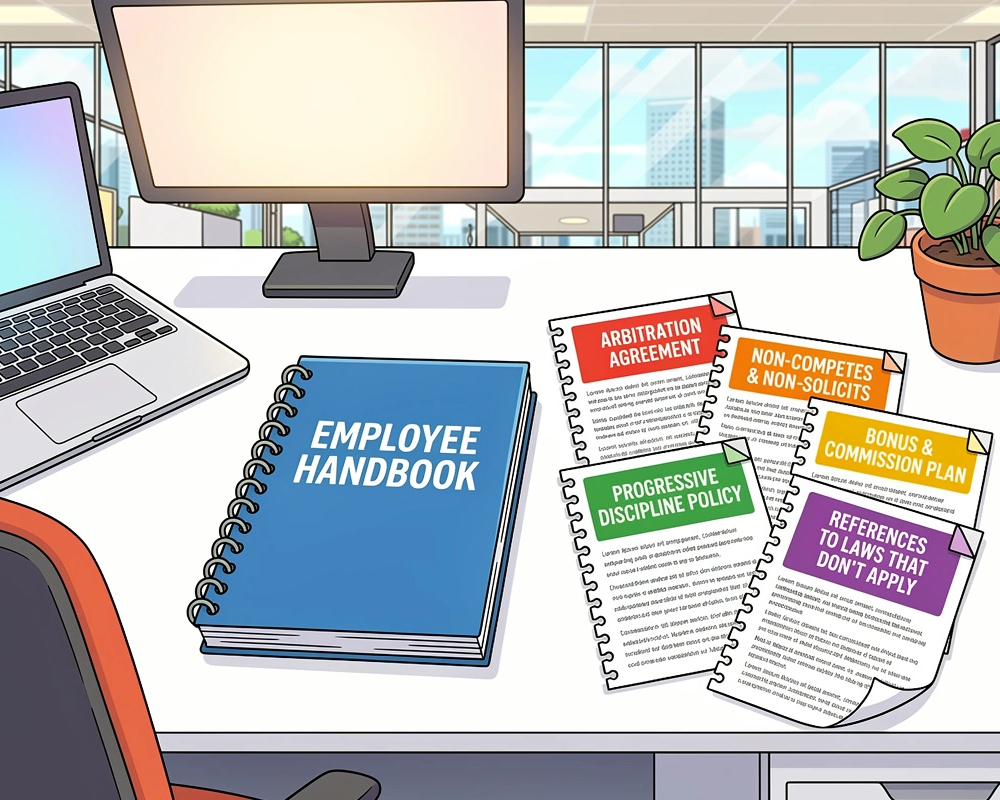
If you’re a subscriber to the RKW Newsletter, you should know our feelings on Employee Handbooks well by now: We recommend them strongly, no matter how big or small your company, and we recommend they be updated once a year or at least every couple of years. Our focus in these articles in the past has typically been on what policies and language need to be included to best protect your company, both legally and practically.
However, I’ve found recently that, for companies that have never had their Handbook reviewed by an employment lawyer, there can be just as much (if not more) danger in what already is in the Handbook as opposed to what is missing. A few recent examples of Handbook provisions I’ve seen that would make me tear my hair out (if I had any):
Arbitration Agreements: Look at the first page of your Handbook. I can almost guarantee that somewhere on there, it says, “This Handbook is not a contract.” (If it doesn’t, it should.) So, if the Handbook is not a contract, don’t put contractual agreements in it! Trying to bind employees to arbitration in a document that specifically disclaims contractual rights is a non-starter.
Non-Competes and Non-Solicits: Same idea as above. These kinds of restrictive covenants offer tremendous value for companies. However, by including them in policy documents, rather than as a standalone agreement, companies are undermining their own ability to use and enforce these tools for protection of their business.
Bonus and Commission Plans: A Handbook is a bad place for detailed compensation commitments, unless they are to be applied for all employees no matter the circumstances. If all employees are not under the same bonus plan, why, as an employer, would you want to advertise what others are receiving? Also, these types of plans often need a level of precision not appropriate for an employee handbook.
Rigid Progressive Discipline Promises: General statements about the types of discipline that can be promulgated (verbal warning, written warning, etc.) are acceptable. However, too many handbooks try to fit every offense into a “Step 1” or a “Step 2” type of procedure that only serves to handcuff the employer. I’ve seen collective bargaining agreements with unions – negotiated over a matter of years -- be less rigid about disciplinary procedures than some employers unwittingly tie themselves to because of their overly restrictive handbook policies.
Discussion of Inapplicable Laws: The worst offender. If your business is under 50 employees, then it and its employees are not covered by the federal Family and Medical Leave Act (FMLA). If that’s the case, there’s no reason to mention it. Not only does doing so create confusion, but there has been case law holding that employees can proceed with state-law claims for breach of contract or promissory estoppel based on handbook language granting FMLA-type leave, even though the employer had less than 50 employees.
Most of these mistakes stem from employers using templates from a former employer, copies received from colleagues at competitors, or accepting format handbooks from their payroll service without having the document reviewed by counsel. Contact an RKW Law Group employment attorney to ensure your company isn’t falling into the same trap.
