
BALTIMORE
10075 Red Run Boulevard
Suite 401
Owings Mills, MD 21117
(443) 738-4900
FREDERICK
10 North Jefferson Street
Suite 200
Frederick, MD 21701
(240) 220-2415
BETHESDA
7315 Wisconsin Avenue
Suite 400W
Bethesda, MD 20814
(240) 220-2415
What Does Retaliation Actually Mean?
May 6, 2026
Anthony Herman
The federal Equal Employment Opportunity Commission (EEOC) publishes data pertaining to charges it receives every year. And in most every year, retaliation is the most common type of charge – i.e., more people claim they have been retaliated against than have suffered any other kind of discrimination.
This underscores what I’ve found in my career as an employment lawyer: most people don’t actually understand what retaliation is.
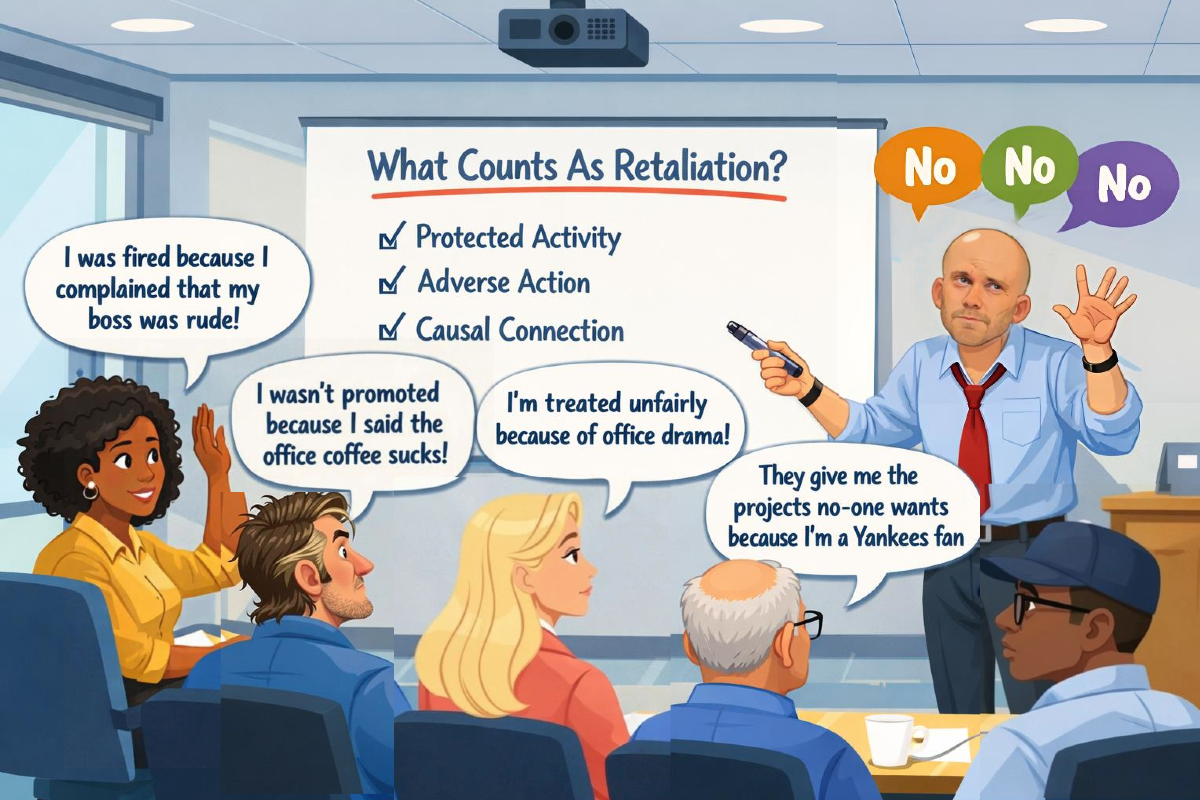
Retaliation, in and of itself, is not grounds for a lawsuit. However, many different employment laws, including all of the significant anti-discrimination laws, prohibit retaliation. To prove retaliation in an employment context, a plaintiff needs to show three things:
- They engaged in a protected activity.
- They suffered an adverse action.
- There was a causal connection between those two events.
The second and third elements are fairly straightforward. Usually, an individual won’t try to bring a retaliation claim unless something bad has happened in their employment (usually a discharge). And while the third element (the causal connection) can be difficult to ultimately prove in a lawsuit, it can be enough at the early stages to point to even close proximity of time between the protected activity and adverse action as evidence of a connection between the two.
However, many people skip right over the first part of the analysis: did the employee actually engage in a protected activity? A protected activity takes place when an employee asserts a right protected by law. That comes in two forms – making a protected complaint or opposing unlawful conduct. Examples of protected activities include complaining about alleged harassment or discrimination; requesting a reasonable accommodation for an individual’s disability, pregnancy or religion; and providing information in an employer’s internal investigation. Those should be pretty obvious.
What isn’t a protected activity is any generic complaint about the workplace or coworkers. Complaints about unfairness, favoritism, rudeness, bullying, bad management, etc. are not protected unless those complaints are tied to discriminatory treatment or some other violation of law. Stating “I am being treated unfairly” to your boss is not a protected activity, and it therefore cannot stand as the basis for a subsequent retaliation claim. However, stating “I am being treated unfairly because of my religion” is a different story.
It’s good business practice to take all complaints seriously, look into them, and to provide the best workplace for your employees that you possibly can. However, understand that not everyone with a workplace gripe has an EEO complaint.
For more questions about how to handle internal complaints received, contact an RKW employment attorney.
