
BALTIMORE
10075 Red Run Boulevard
Suite 401
Owings Mills, MD 21117
(443) 738-4900
FREDERICK
10 North Jefferson Street
Suite 200
Frederick, MD 21701
(240) 220-2415
BETHESDA
7315 Wisconsin Avenue
Suite 400W
Bethesda, MD 20814
(240) 220-2415
Staying Mission-Focused During Election Season: Political Activity Limits for 501(c)(3) Organizations
October 28, 2026
Don Walsh
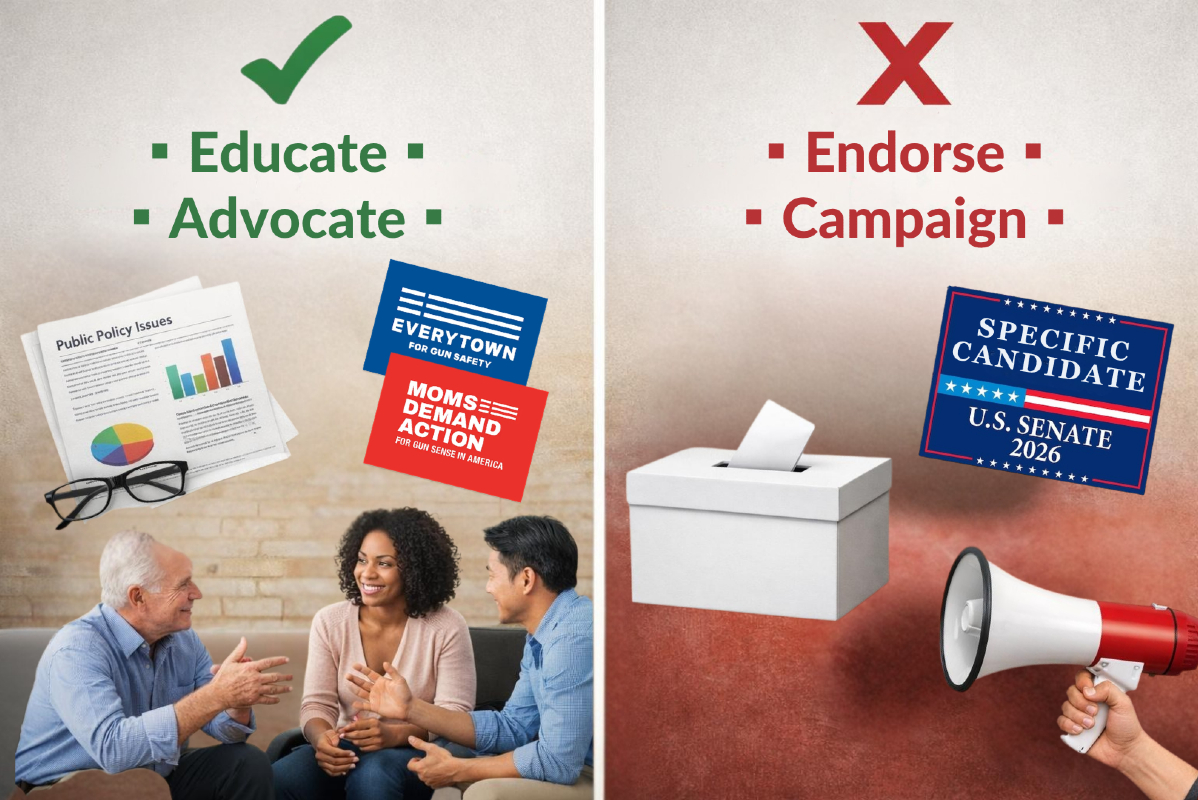
I was recently speaking with a nonprofit client about the election and her speculation whether political changes would be met with increased retribution on nonprofits supporting political change. The conundrum facing the client, masked under her passion, was the legal limitations on her organization as a 501(c)(3). During election season, the draw is strong for nonprofits to address public policies affecting their missions and communities. Although 501(c)(3) organizations may advocate on public issues, federal tax law distinguishes issue advocacy from supporting or opposing candidates. Understanding this distinction helps protect tax-exempt status while advancing the mission.
The Fundamental Rule: No Political Campaign Intervention
Section 501(c)(3) prohibits qualifying nonprofits from directly or indirectly participating in political campaigns for or against candidates for elective public office. The prohibition applies to local, state, and federal elections. It covers endorsements, campaign contributions, partisan communications, and organizational resources used to support or oppose candidates. Violations may lead to revocation of tax-exempt status and excise taxes. The prohibition is absolute, though its application depends on the circumstances.
Nonprofits may still educate the public, advocate for policies, conduct nonpartisan civic activities, and engage in lobbying within applicable limits. Where the line is crossed is very dependent on facts and circumstances. Possible prohibited political activity is illustrated in IRS Revenue Ruling 2007-41 and related guidance.
Practical Steps To Protect Your Organization
Reduce compliance risks with these practices:
Nonprofit organizations play an important role in educating communities, addressing social needs, and helping people understand public policy. Federal law allows 501(c)(3) organizations to continue much of this work, but it does not permit them to use their charitable platforms to support or oppose candidates for elective office. Protecting the mission, however, does not require silence. The central question is not simply whether an activity involves politics. It is whether the organization is engaging in prohibited campaign intervention, permissible issue advocacy, nonpartisan civic engagement, or lobbying that remains within the applicable limits.
By establishing clear policies, reviewing communications, training personnel, and seeking professional advice when necessary, nonprofits can remain active in their communities while safeguarding their charitable purpose and tax-exempt status.
If you need assistance in establishing your policies, reviewing your conduct or training your staff and board, please reach out to RKW.
