
BALTIMORE
10075 Red Run Boulevard
Suite 401
Owings Mills, MD 21117
(443) 738-4900
FREDERICK
10 North Jefferson Street
Suite 200
Frederick, MD 21701
(240) 220-2415
BETHESDA
7315 Wisconsin Avenue
Suite 400W
Bethesda, MD 20814
(240) 220-2415
Recording Time
May 21, 2026
Laura L. Rubenstein
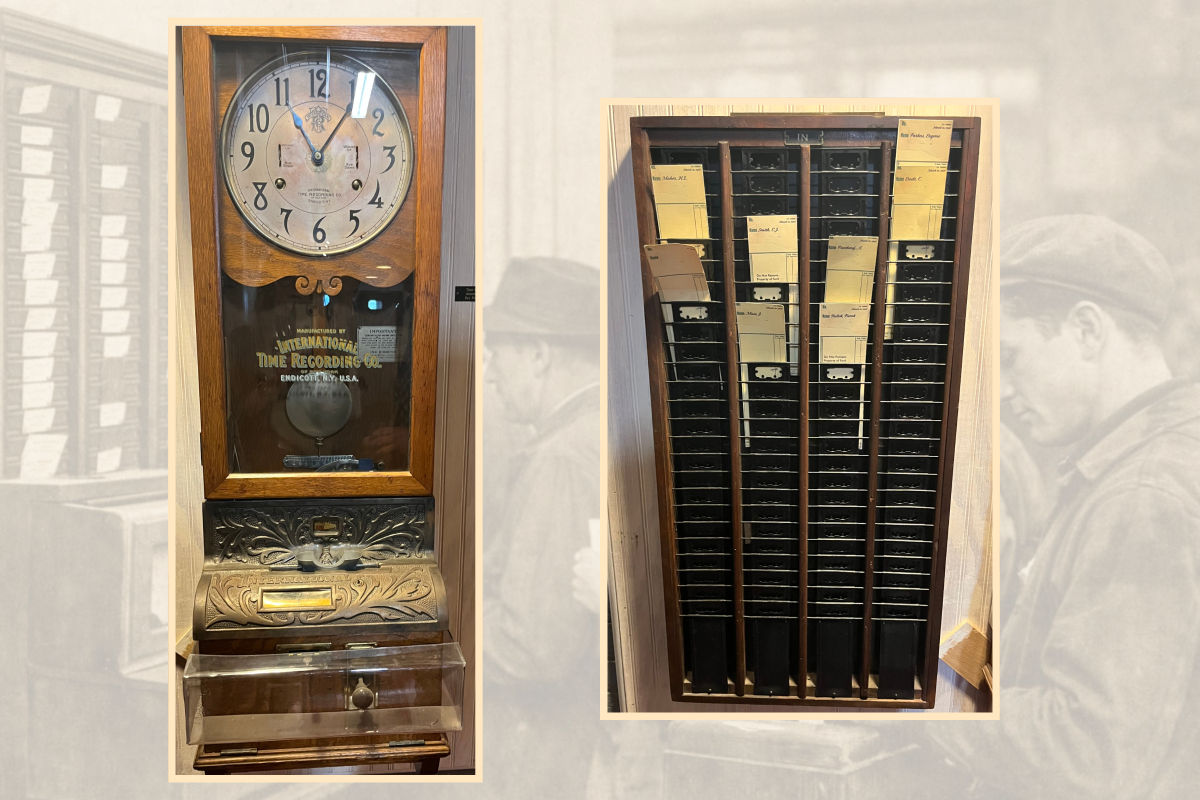
Last week, I visited the Ford Piquette Avenue Plant in Detroit, Michigan with a group of accomplished labor and employment lawyers from across the country. The historic factory is where Henry Ford developed and produced the early Model T automobile. Our tour guide was extremely knowledgeable about the engineering feats represented by each pristine model in the museum’s collection. But what caught my nerdy eye was a small clock displayed near the factory floor — one of the original employee time clocks created by The International Time Recording Company. Next to it were timecards in slots, each labeled with a different name. It was a wonderful reminder of how employees tracked their time each day so Ford could pay them accurately.
The time clock — invented by Willard Le Grand Bundy in New York in 1888 — standardized the “punch in” and “punch out” routine, creating one of the earliest systematic approaches to tracking employee time and attendance in American industry. That simple device helped shape modern attendance practices, employment laws, and workforce management.
According to the museum’s history, employees at the Ford plant had their timecards stamped in red ink if they arrived even one minute late. In the industrial era, punctuality was viewed as essential to factory efficiency, especially as assembly-line production expanded. Employers relied on attendance policies not only to maintain productivity, but also to promote fairness and consistency across large workforces — and the punch clock became a tool for enforcing workplace discipline.
Over time, punch clocks evolved alongside wage-and-hour laws. Today, timekeeping systems are primarily used for hourly, non-exempt employees whose hours must be recorded accurately under the federal Fair Labor Standards Act and comparable state laws. Mechanical cards and wall-mounted clocks have largely been replaced by electronic systems, including swipe badges, biometric scanners, mobile applications, and cloud-based payroll platforms that can automatically calculate hours worked, overtime, paid leave, and benefit eligibility, among other things.
Technology has made timekeeping substantially more efficient, but it has also introduced new compliance challenges. Electronic systems can reduce mathematical errors and improve record retention, yet employers must remain vigilant about off-the-clock work, automatic meal-break deductions, and tracking time for remote employees. In many workplaces, attendance expectations remain just as important today as they were at Ford’s Piquette plant — even if the red ink has disappeared.
There is also ongoing debate about whether modern systems are easier to manipulate than traditional punch clocks. While biometric tools and electronic audit trails can strengthen accountability, digital systems may still be vulnerable to “buddy punching,” inaccurate remote logins, or unauthorized edits if employers lack proper safeguards. The underlying lesson from Henry Ford’s factory remains relevant: accurate timekeeping is not simply administrative — it is fundamental to workplace fairness, payroll compliance, and operational trust.
For questions about your record keeping practices at your workplace, reach out to an RKW employment lawyer.
