
BALTIMORE
10075 Red Run Boulevard
Suite 401
Owings Mills, MD 21117
(443) 738-4900
FREDERICK
10 North Jefferson Street
Suite 200
Frederick, MD 21701
(240) 220-2415
BETHESDA
7315 Wisconsin Avenue
Suite 400W
Bethesda, MD 20814
(240) 220-2415
Gestational Carrier Contract Debacle Involving Four States and the U.S. Supreme Court
September 30, 2026
Marjorie Just
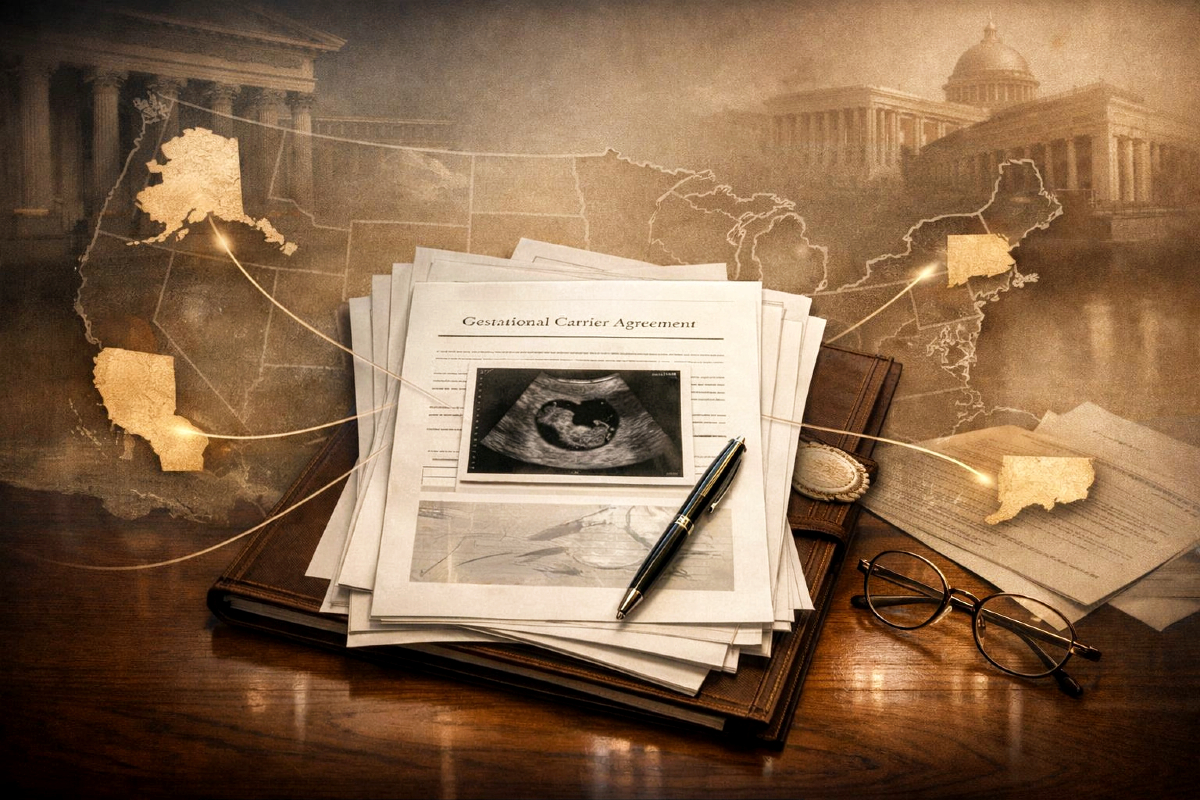
When parties enter into a contract for family formation, the last thing they want or expect, is to end up in litigation involving four states and the U.S. Supreme Court, while a newborn’s life hangs in the balance requiring specialized and risky medical care. But that is what happened when intended parents – and biological parents –Nausheen Gilkar and Omar Ahmed, entered into a Gestational Carrier agreement with McKenna West.
While the news media has referred to Ms. West as a “surrogate,” she was not a traditional surrogate in the sense that she did not contribute an egg to the creation of the fetus. (See Terri Langford and Katlyn Ma, Baby at Center of Surrogacy Rights Case is Born in Dallas, Texas Trib., August 12, 2026; J. David Goodman, One Woman Conceived a Baby. One Carried Him. Who’s the Mother? N.Y. Times August 25,2026; James Stengle and Anna Wilder, California Couple Confront their Surrogate in a Texas Court as Dispute over Newborn Escalates, Assoc. Press,August 26, 2026; Maya Yang, US Supreme Court Declines to Intervene in Custody Fight over Baby Born Via Surrogate, The Guardian, September 22,2026.) Only Ms. Gilkar and Mr. Ahmed contributed genetic material (egg and sperm). The egg was fertilized in a lab,and then implanted into Ms. West’s uterus where it would hopefully grow until birth. Ms. West contracted to have the embryo implanted in her uterus and to carry it until birth. As such, Ms. West was not genetically related to the baby.
The Gestational Carrier method, where the carrier is not biologically related to the baby, has become more prevalent in the last 20+ years than traditional surrogacy. Using the gestational carrier method, parties and their attorneys hoped to avoid disputes over who would be the legal parents of the baby born as a result of these agreements, and who may have custody of the baby, since the Gestational Carrier would not be a biological parent. Unfortunately, that did not prevent the messy litigation and tragic circumstances in this instance.
A hopeful family formation contract went sideways when medical care revealed that the fetus had hypoplastic left heart syndrome, which is life threatening and would require open-heart surgery. The biological parents asserted that after medical consultation and research, they and the gestational carrier all agreed to terminate the pregnancy, while the carrier asserted that she was being forced to terminate the pregnancy. Whether initially objecting, or later, the carrier decided she would not agree to terminate the pregnancy, despite their contract containing a clause that the biological parents could require termination under certain circumstances including this one.
Whatever one’s opinions about abortion, the dispute quickly transitioned to a dispute of who was the legal parent and who could make medical decisions for the baby in a life-threatening situation. Litigation was filed in Alaska, where the gestational carrier lived; in California, where the biological parents lived; and in Texas, where the gestational carrier fled to give birth. Further, the company that had matched the gestational carrier to the parents is based in Connecticut. That company can expect litigation in the near future if it has not already been filed against them.
The gestational carrier fled to Texas to give birth there because Texas state law outlaws abortion and provides that anyone who gives birth in Texas is recognized as the legal mother of the child. The gestational carrier sued in Texas to be declared the legal parent of the baby, and for custody rights to be able to make medical decisions for the child. She argued that because the biological parents had at one point advocated for a termination of the pregnancy, they could not be trusted to make decisions in the baby’s best interests. This litigation occurred after the California state Court entered an order that the biological parents, and not the gestational carrier, are the legal parents of the baby. Texas attorney general Ken Paxton entered the Texas litigation on behalf of the gestational carrier, making the case national news in defying the California state Order. So then there was a dispute between two states about who the legal parents of the baby are.
A Dallas, Texas, Judge initially issued an order requiring that the baby born in Texas remain in Texas and receive medical treatment there. However, the same Texas judge also granted the biological parents’ request to be the sole decisionmakers for the baby, and preventing the gestational carrier from making any medical decisions for the baby, and from representing herself as the child’s mother. In this way, the Texas Court kept the baby and the dispute in Texas, but reinforced the California Order recognizing the biological parents as the legal parents.
The Texas Supreme Court then entered an order permitting the baby to leave Texas with the biological parents and relocate to a California hospital for further treatment. The gestational carrier then petitioned the U.S. Supreme Court on an emergency basis to stay the California Order recognizing the biological parents as the legal parents,and instead award her custody rights. This week, the Supreme Court denied the gestational carrier’s emergency request and declined to take up the case, leaving the California Order in effect.
While no one wants this to be their path to family formation, having an experienced Family Law litigator guiding you both in the negotiation of assisted reproduction contracts, and in handling any disputes that may arise, is essential.
