BALTIMORE
10075 Red Run Boulevard
Suite 401
Owings Mills, MD 21117
(443) 738-4900
FREDERICK
10 North Jefferson Street
Suite 200
Frederick, MD 21701
(240) 220-2415
BETHESDA
7315 Wisconsin Avenue
Suite 400W
Bethesda, MD 20814
(240) 220-2415
From the Red Carpet to the Courtroom: Why Getting Your Estate Plan in Place Matters
March 26, 2026
Alicia M. Balanesi
Estate planning is easy to postpone. It rarely feels urgent, and many people assume they have plenty of time to get “things in order” at a later time. Yet some of the most high-profile—and costly—mistakes come from individuals who had every resource available but failed to put proper plans in place.
The result? Confusion, conflict, and millions lost. These cautionary tales underscore a simple truth: estate planning is not just for the wealthy—it is essential for everyone.
Take Prince, whose untimely death in 2016 shocked the world. Despite an estate valued at over $150 million, he died without a will. Because he didn’t have a will, Minnesota state law declared who would inherit, being his closest heirs – his living siblings. This led to over 45 people with “claims” to be his siblings – a nightmare of the probate process. What followed was years of litigation among the potential heirs, unclear determinations of who was entitled to inherit, and substantial administrative and legal costs and taxes of over 60 million dollars in settling the estate. The absence of even a basic estate plan turned what could have been a straightforward process into a prolonged and public legal battle.
Similarly, Aretha Franklin passed away in 2018 without a formal, clearly executed will—at least initially. Multiple handwritten documents were later discovered, including one found in a couch cushion—which the court in Michigan actually declared to be valid. While Michigan law allows handwritten wills under certain circumstances, the lack of clarity and consistency led to disputes among her heirs. Over five years after her passing, her estate remained entangled in court proceedings, illustrating how informal, or do-it-yourself, estate planning can create as many problems as no planning at all.
Even individuals who do create estate plans can run into trouble if those plans are not carefully structured and assets are not properly titled. James Gandolfini, best known for his role in The Sopranos, had a will in place at the time of his death. However, much of his estate passed through his will rather than through tax-efficient structures such as trusts. As a result, a significant portion of his estate was subject to estate taxes—reportedly costing tens of millions of dollars that could have been minimized with more strategic planning, or with the proper asset titling.
These examples highlight several key lessons. First, having no plan at all can lead to uncertainty, delay, and unnecessary expense. Second, informal or incomplete planning can create ambiguity and conflict among loved ones. Third, even a plan that exists on paper may fall short if it is not designed with tax efficiency, correct asset titling, and practical administration in mind.
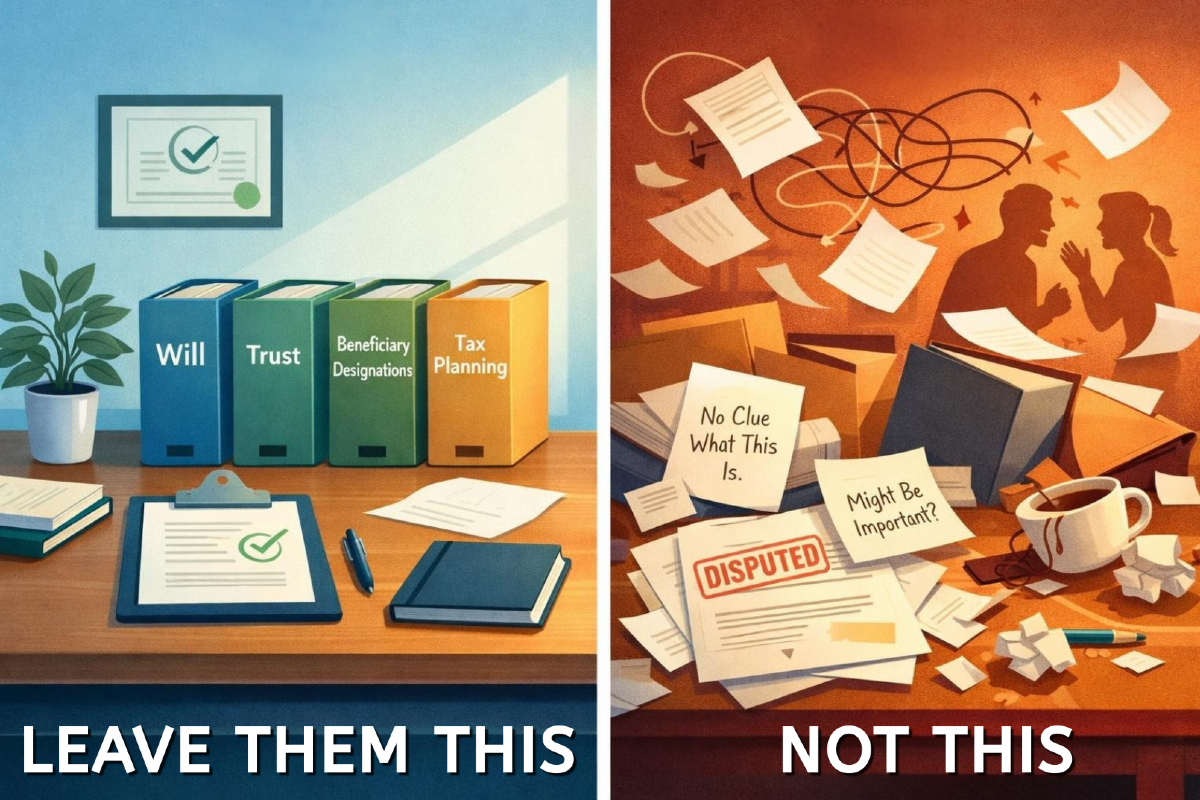
While not always making headlines, these common mistakes happen to all individuals and families. The stakes may look different, but the underlying risks are the same. Without a will or trust, here in Maryland, state law will dictate how your assets are distributed—often in ways that may not reflect your wishes. And without proper titling and beneficiary designations, even modest estates can encounter avoidable complications. The good news is that these outcomes are entirely preventable. A thoughtfully prepared estate plan provides clarity, reduces stress for your loved ones, and ensures your assets are distributed according to your intentions. It can also incorporate tax planning strategies, guardianship designations for minor children, and mechanisms to manage assets responsibly over time.
Estate planning is not about predicting the future—it is about preparing for it. As the experiences of high-profile individuals demonstrate, no one is immune to the consequences of inaction or incomplete planning. Taking the time now to put a comprehensive plan in place is one of the most important steps you can take to protect your legacy and your family.