
BALTIMORE
10075 Red Run Boulevard
Suite 401
Owings Mills, MD 21117
(443) 738-4900
FREDERICK
10 North Jefferson Street
Suite 200
Frederick, MD 21701
(240) 220-2415
BETHESDA
7315 Wisconsin Avenue
Suite 400W
Bethesda, MD 20814
(240) 220-2415
Contempt of Court may not be available for custody violations in Maryland
April 23, 2026
Marjorie Just
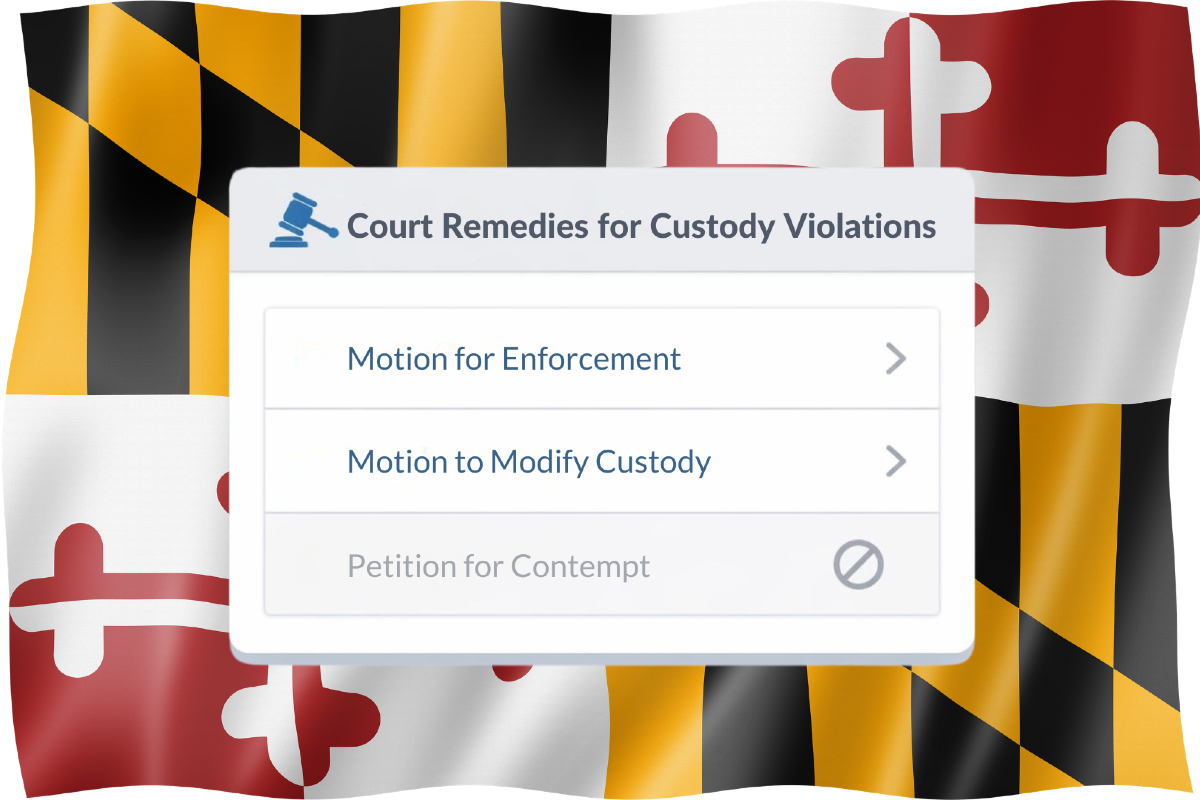
Under the case of Breona C. v. Rodney D., 253 Md. App. 67, 263 A.3d 1090 (2021), the Appellate Court of Maryland clarified what contempt remedies are or are not available to someone whose co-parent withholds access under a custody order. Since this decision was reported, parents and family lawyers in Maryland need to reconsider their remedies and strategies when a parent refuses to comply with a custody order.
In Breona C., the mother withheld access of the child to father for an extended period of time. The father sought an order of contempt and the contempt hearing occurred approximately nine months later, with emergency motions filed in between. For several months before the hearing, the child was returned to the father, such that at the time of the hearing, the mother was complying with the custody order. So the subject of the contempt hearing was the mother’s custody order non-compliance several months earlier, that was not ongoing by the time of the hearing. The Trial Court granted a contempt order which provided no sanction, but stated that the Mother could purge her contempt by strictly complying with the pre-existing custody order. The mother appealed and the Appellate Court held that the trial Court’s order for contempt was improper as it did not follow the requirements of contempt findings, sanctions and purge provisions.
Civil Contempt of a court order is a violation of a court order in the presence of the Court. Constructive civil contempt is a violation of a court order that does not occur in the presence of the Court, such as withholding access of a child in violation of the terms of a custody order. To be successful on a petition for constructive civil contempt, one must prove the violation. However, a petition for constructive civil contempt is one that seeks a remedy designed to coerce future compliance with the original order. As a result, a Court’s order for constructive civil contempt must be based on a finding of a violation, and must include (a) a sanction, (b) a specific purge provision that contemnor may meet to avoid the sanction and (c) be designed to coerce future compliance rather than punish for past conduct. The Breona C. case narrows the interpretation of these elements.
First the Appellate Court required that the violation not be a past incident but rather ongoing at the time of the hearing. So even if a child is withheld in violation of a custody order for weeks, as occurred in Breona C., if the alleged contemnor is in compliance at the time of the hearing several months later, it is likely that no contempt will be found. Second, a sanction must be imposed, and a purge provision that is specific that the contemnor may perform to avoid the sanction. The purge provision cannot be simply “comply with the previous order”. Put simply, the first order did that already. The purge provision must be something new, and it must coerce future compliance, not punish past non-compliance.
In Breona C., the Appellate Court found there was no ongoing violation at the time of the hearing on which to base a contempt order, and there was no sanction. Further, the Court found that the purge provision was a vague “comply with the previous order”; as such it did not permit the alleged contemnor to avoid the sanction through specific conduct. And finally, the Court found that the order was punishing past conduct rather than coercing future compliance, and therefore was improper.
The popular belief that holding someone in “contempt of court” is the Court’s punishment for past behavior is not quite accurate, especially in Maryland and especially with regard to custody violations. Particularly given the decision in Breona C., parents dealing with a co-parent who violates a custody order need to carefully consider their possible remedies and paths to seek them whether that is a petition for contempt, a motion for enforcement with no contempt request, or a motion to modify custody. An experienced family lawyer is essential in navigating these waters.
